PostHog × One | Rust meetup

From Snakes to Crabs
Rewriting PostHog’s feature flag platform in Rust.

Dylan Martin
@dmarticus
Tech lead, PostHog

Who I am
Dylan Martin
(Former) tech lead, Feature Flags @ PostHog

02
Mental model · what our service does
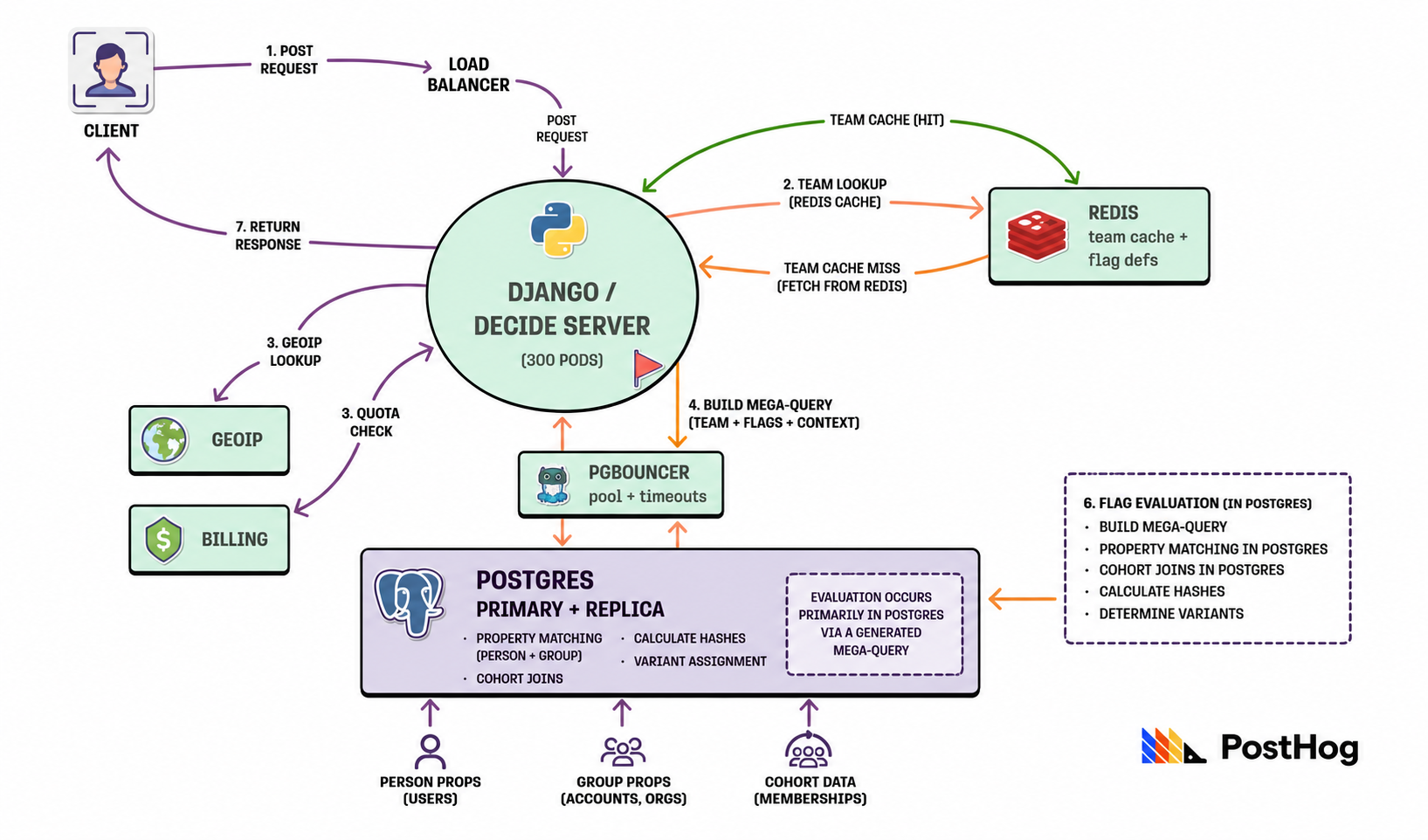
03
Section 01
The problem.
What was structurally wrong with the old Python service.
Section 01 / The problem
Three things were wrong with the old service.
01
The ORM
02
The runtime
03
Connection pooling
01
05
Section 01 / The problem · The ORM
Evaluating all flags was one big mega-query
-- ONE query per request. Conditions for EVERY flag,
-- evaluated inline by Postgres:
SELECT person.id, person.properties,
  (person.properties->>'email' LIKE '%@acme.com' AND
   (person.properties->>'plan')::text = 'enterprise') AS flag_a,
  (cohort.id = ANY($2)) AS flag_b,
  -- ... one expression per flag, for every flag
FROM person
  LEFT JOIN cohortpeople ON cohortpeople.person_id = person.id
  LEFT JOIN cohort ON cohort.id = cohortpeople.cohort_id
WHERE person.team_id = $1 AND person.id = $3;
06
Section 01 / The problem · The ORM
Why that one query didn't scale.
01
JSONB matching can't use an index
02
Query cost grows with every flag
03
Operators with no SQL form
07
Section 01 / The problem
Three things were wrong with the old service.
01
The ORM
02
The runtime
03
Connection pooling
01
02
08
Section 01 / The problem · The runtime
Python couldn't use the box.
Pod · 8 cores
Sync workers block a whole process on the DB, and the GIL pins Python to one core per worker
09
Section 01 / The problem
Three things were wrong with the old service.
01
The ORM
02
The runtime
03
Connection pooling
01
02
03
10
Section 01 / The problem · Connection pooling
Timeouts trapped in PgBouncer.
# Postgres caps out in the low hundreds, so thousands of
# workers funnel through PgBouncer. Our deadlines live there too:
query_timeout      = 15
query_wait_timeout = 10

# in the Django request handler:
# …no real per-request deadline we could reach.
A separate system, clunky to tune
11
Section 02
Choosing Rust.
What the replacement had to do, and why Rust cleared the bar.
Section 02 / Choosing Rust
What the replacement had to solve.
01
Evaluate flags outside the database
02
A genuinely fast async runtime
03
Connection pooling without PgBouncer
13
Section 02 / Choosing Rust
Why Rust won.
| Async PythonFastAPI | NodeHyperExpress | RustTokio | |
|---|---|---|---|
| Eval off the ORM | No | Yes | Yes |
| Fast async runtime | Async, still slow | Async, slower than Rust | Fast and async |
| Pool without PgBouncer | No | Needs a proxy | Native, via sqlx |
| Team can ship it | Yes | Yes | Yes |
| Verdict | Same problems, deferred | Forced into a proxy | Won or tied on everything |
14
Section 03
Build it without losing what we knew.
Tests were my best friend.
Section 03 / Implementation · The loop
One module at a time.
01
Stand up the new endpoint
→
02
Rewrite a module
↑
↺
↓
04
Add integration tests
←
03
Port its tests
16
Section 03 / Implementation · Synthetic test framework
Then, test it with real data.
Local build
All prod flags + a test-bed of users
users built to match across every flag
──▶
Old
Django, local
New
Rust, local
──▶
Diff
Fix edge cases
↺ repeat
17
Section 03 / Implementation
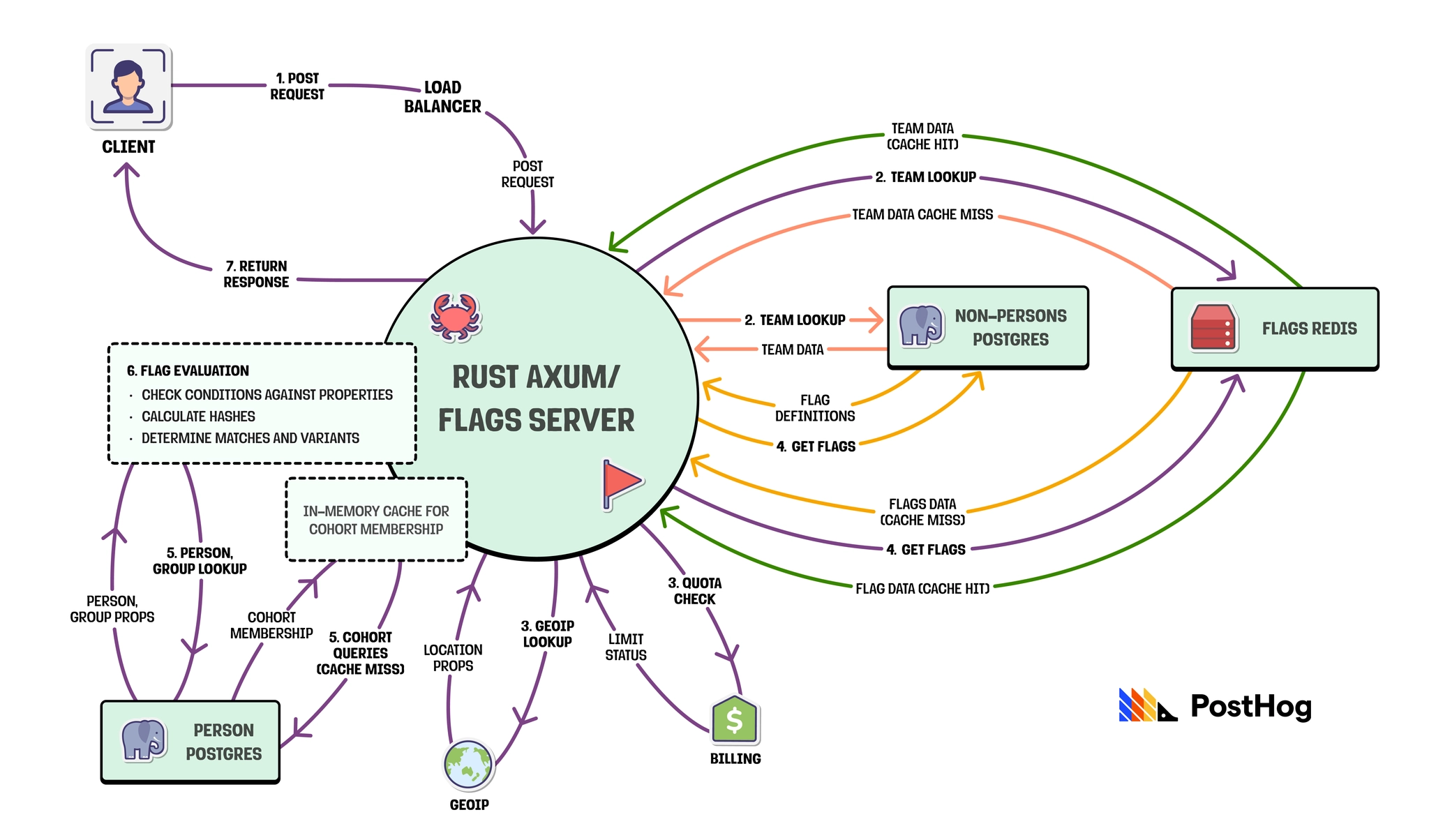
What changed in the new service.
01
Evaluation in app memory
Flag matching moved out of Postgres SQL — fetched raw, matched in parallel.
02
Cohorts cached in-memory
No re-joining membership on every request.
03
Direct pool management
Pools managed through sqlx at the app level. PgBouncer gone.
01
02
03
18
Section 03 / Implementation · The Rust that mattered
Pooling moves in-process.
// sqlx owns the pool — no PgBouncer in the path.
let pool = PgPoolOptions::new()
    .max_connections(20)
    .acquire_timeout(Duration::from_millis(50))
    .connect(&url).await?;

// And the deadline lives in our code, per request:
let row = timeout(Duration::from_millis(100), q.fetch_one(&pool)).await?;
One pool per pod, bounded and shared across tasks. PgBouncer gone, timeouts back where we can reach them.
19
Section 03 / Implementation · The Rust that mattered
Match every flag in parallel.
// Fetch raw properties once, then fan the matching
// out across cores — the thing the GIL never allowed.
let results: Vec<FlagMatch> = flags
    .par_iter()                       // rayon
    .map(|flag| flag.evaluate(&props))
    .collect();
Postgres stops doing application work; the CPU-bound match runs on all the cores, in memory.
20
Section 04
Shipping it without breaking production.
Taking advantage of an existing service.
Section 04 / Rollout
Roll out by hashing the API token.
22
Section 05
The results.
What the rewrite actually bought us.
Section 05 / Results
Latency.
p99
904ms
85ms
10.6× faster · 90.5% reduction
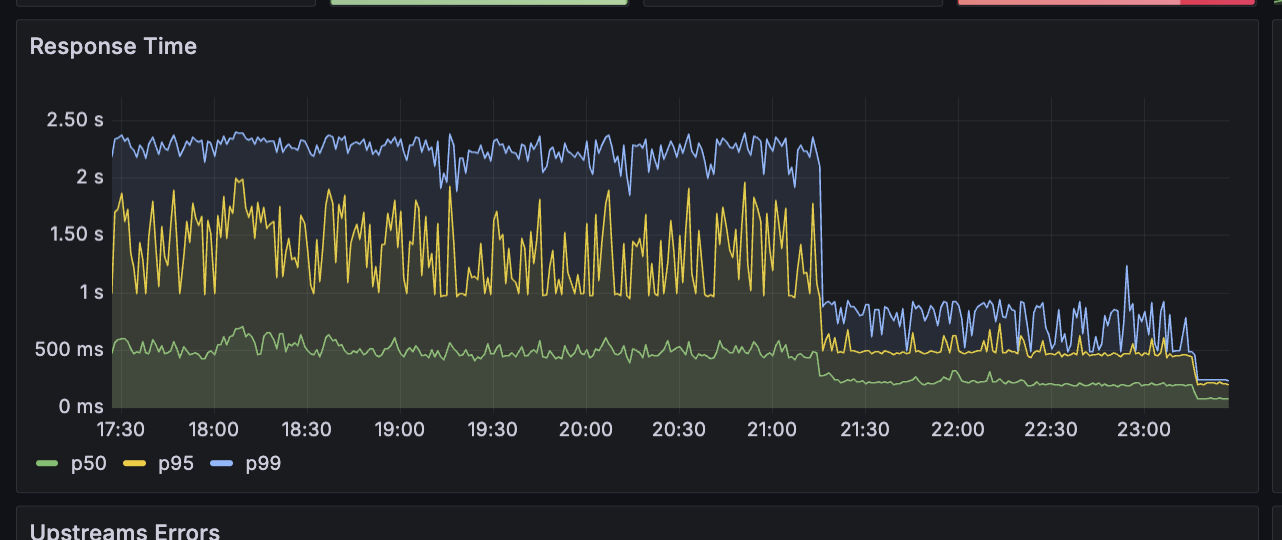
Response time across the rollout. Cutover ≈ 21:15.
p95381 → 43 ms
p90160 → 31 ms
p5022 → 12 ms
24
Section 05 / Results
Cost.
Pods
300
→
90
−70%
Compute spend
$8.8k
→
$2.8k
−68%
Traffic
500k rpm
→
730k rpm
+46%
25
Section 05 / Results · where it stands now
Bonus: here's now
p99 today
25ms
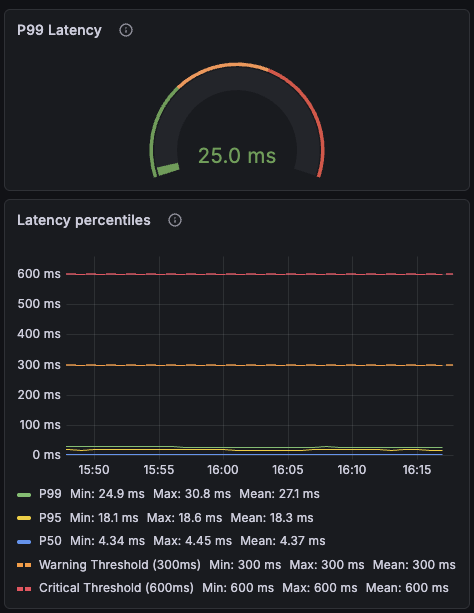
Live dashboard · May 2026.
26
SECTION 06
Reflection.
What I'd do differently, and what to take home.
Section 06 / Reflection
What I'd do differently.
Property-based testing.
Load testing infrastructure.
Leverage AI more heavily.
28
Section 06 / Reflection
What I'd do differently.
Property-based testing.
Load testing infrastructure.
Leverage AI more heavily.
29
Section 06 / Reflection
What I'd do differently.
Property-based testing.
Load testing infrastructure.
Leverage AI more heavily.
30
End
Thank you.Questions?
Read more
- Part 1 · posthog.com/blog/even-faster-more-reliable-flags
- Part 2 · posthog.com/blog/untangling-tokio-and-rayon
Find me
- dylanamartin.com
- github.com/dmarticus
- linkedin.com/in/dmarticus