Stateless ClickHouse
for stream processing
How we turned ClickHouse itself into our Kafka → CH inserter — and deleted the service we were about to build.
James Greenhill · no MergeTree required

Me, and the firehose
James Greenhill — Member of Token Burning Staff, PostHog.
PostHog = open-source product analytics, session replay, feature flags, data warehouse. All the analytical data lives in ClickHouse.
The pipeline that stopped scaling
Kafka table engines, living on the data nodes.

Kafka → CH, the classic recipe
Kafka table engine is a consumer. A materialized view fires on each inserted block and writes into the real MergeTree table. Elegant — pull-based, resilient to spikes, no external writer.
One box, two jobs, fighting
- Ingestion and queries share the same nodes. A query storm starves Kafka consumption — and vice-versa.
- No headroom to recover. If we ever took lag — paused ingestion for any reason — then at above-average peak we didn't have the throughput to catch back up. We'd just keep falling further behind.
- Scaling consumers meant scaling storage nodes — the expensive, stateful, hard-to-move ones.
The insert is the cheap part. Most of the CPU goes to denormalizing properties off every event — parsing the JSON and writing it into Map columns and dozens of materialized columns. On shared nodes, that work fights your queries for the same cores.

Our data nodes, every time a dashboard fired a heavy query while the Kafka consumers were trying to keep up.
Plan A: build an inserter service
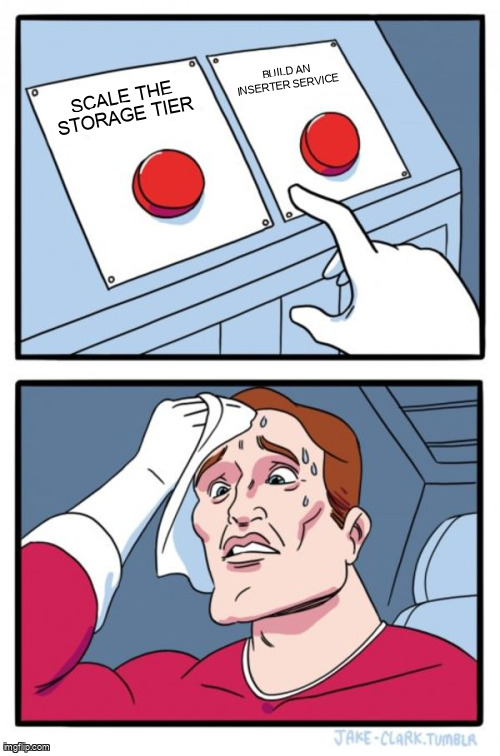
The hard part was never the consumer loop — it was the schema. An inserter has to denormalize events into our ever-changing dynamic event schema, which we'd then maintain in two surface areas: once in Go, once in ClickHouse SQL. Wrangling prop Maps and materialized columns in one place was already painful.
And the types would drift subtly between Go and ClickHouse — versus ClickHouse feeding native ClickHouse, one type system end to end.
How far Plan A got, in full (~/inserter):
module github.com/posthog/inserter
go 1.20
// ...line 3 was never written.   (Apr 2023)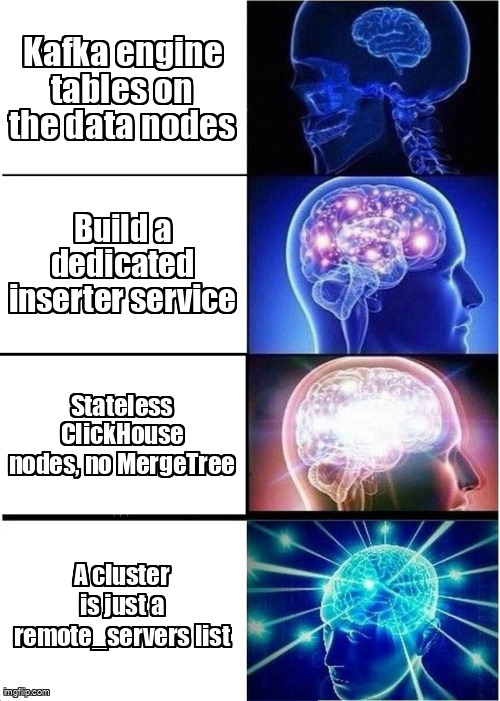
The evolution of our ingestion takes — ending on the enlightenment.
The insight
We didn't need a new service. We needed a new role for ClickHouse.
A "cluster" is just a logical list
In ClickHouse, a cluster is just a <remote_servers> entry — and one config can declare many. Nodes can live anywhere, run anything, and be added at will.
<remote_servers>
    <posthog>                       <!-- storage cluster: 10×3 on EC2, NVMe -->
        <shard><replica><host>data-1</host></replica> ... </shard> ...
    </posthog>
    <ingestion-events>              <!-- a SEPARATE cluster: stateless K8s pods -->
        <shard><replica><host>chi-ingestion-events-0</host></replica></shard> ...
    </ingestion-events>
</remote_servers>
EC2 storage and stateless K8s ingestion are separate clusters — just two entries in the same list. The pods are their own cluster; their Distributed tables target posthog to forward writes. Different hardware, bridged by the Distributed engine — never one mixed cluster.
The inserter we wanted... is a ClickHouse node
Consume from Kafka? Kafka table engine.
Transform + batch? Materialized view.
Route to the right shard and INSERT? Distributed engine.
Every feature we'd have built into the inserter, ClickHouse already ships. So run those three objects on a node that stores nothing.
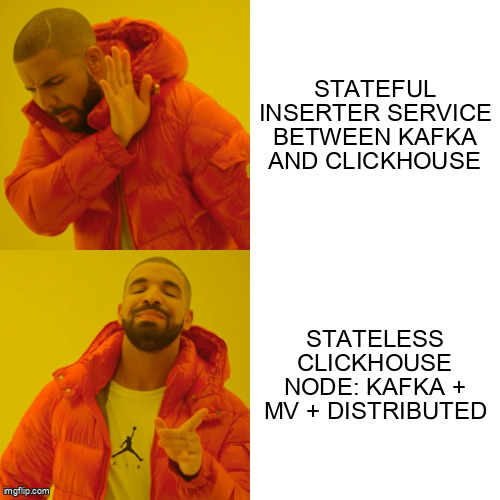
Build-vs-reuse, in one frame.
You probably don't need an inserter service.
ClickHouse is already a perfectly good stream processor. Give it a node with no disk to worry about.
How it works
Four objects. Two node roles. One native-protocol hop.

Four objects, split across two roles
DATA nodes
INGESTION nodes (stateless)
The MV reads from the Kafka table and writes to the writable Distributed table. The Distributed table forwards to the MergeTree on the data nodes. Done.
The only place that actually stores rows
CREATE TABLE IF NOT EXISTS groups
(
    group_type_index UInt8,
    group_key        VARCHAR,
    created_at       DateTime64,
    team_id          Int64,
    group_properties VARCHAR,
    _timestamp       DateTime,
    _offset          UInt64
)
ENGINE = ReplicatedReplacingMergeTree(
    '/clickhouse/tables/{shard}/posthog.groups', '{replica}', _timestamp)
ORDER BY (team_id, group_type_index, group_key)
Plain replicated MergeTree. It has no idea Kafka exists. This is the only stateful piece.
A Distributed table is the "INSERT client"
CREATE TABLE IF NOT EXISTS writable_groups
(
    group_type_index UInt8, group_key VARCHAR, created_at DateTime64,
    team_id Int64, group_properties VARCHAR, _timestamp DateTime, _offset UInt64
)
ENGINE = Distributed('posthog_single_shard', 'default', 'groups');
Non-sharded target → point the Distributed table at posthog_single_shard. Sharded target → use the full posthog cluster with a sharding key:
ENGINE = Distributed('posthog', 'default', 'sharded_events', sipHash64(distinct_id));The consumer
CREATE TABLE IF NOT EXISTS kafka_groups
(
    group_type_index UInt8, group_key VARCHAR, created_at DateTime64,
    team_id Int64, group_properties VARCHAR
)
ENGINE = Kafka(warpstream_ingestion,            -- named collection (broker list)
    kafka_topic_list = 'groups',
    kafka_group_name = 'group1',
    kafka_format     = 'JSONEachRow');
Broker lists come from named collections — which is how we run MSK and WarpStream side by side (more later). One consumer per INGESTION_SMALL node; more on the hotter tiers.
The wire between consumer and writer
CREATE MATERIALIZED VIEW IF NOT EXISTS groups_mv
TO writable_groups            -- ← writes into the Distributed table
AS SELECT
    group_type_index, group_key, created_at, team_id, group_properties,
    _timestamp, _offset
FROM kafka_groups;            -- ← reads from the Kafka table engine
Selecting from the Kafka table advances consumer offsets. The MV fires per block, transforms, and pushes into writable_groups → which forwards to the data nodes. That's the whole inserter.
The whole path
stateless ingestion pod (K8s)
(data nodes)
Native-protocol INSERT over the cluster. The pod holds no data — kill it, replace it, scale it, nothing is lost.
One migration, role-aware placement
operations = [
    run_sql_with_exceptions(GROUPS_TABLE_SQL(),          node_roles=[NodeRole.DATA]),
    run_sql_with_exceptions(GROUPS_WRITABLE_TABLE_SQL(), node_roles=[NodeRole.INGESTION_SMALL]),
    run_sql_with_exceptions(KAFKA_GROUPS_TABLE_SQL(),    node_roles=[NodeRole.INGESTION_SMALL]),
    run_sql_with_exceptions(GROUPS_TABLE_MV_SQL(),       node_roles=[NodeRole.INGESTION_SMALL]),
]
No ON CLUSTER. run_sql_with_exceptions fans each statement to exactly the hosts whose macro hostClusterRole matches — so the MergeTree lands on storage, and Kafka/MV/Distributed land on the stateless tier.
Ingestion is tiered by throughput
class NodeRole(StrEnum):
    DATA              = "data"        # the sharded MergeTree storage cluster
    INGESTION_SMALL   = "small"       # 1 Kafka consumer  — low-volume topics
    INGESTION_MEDIUM  = "medium"      # 4 Kafka consumers — mid-volume
    INGESTION_EVENTS  = "events"      # the main event firehose, many shards
    SHUFFLEHOG        = "shufflehog"  # re-partitions events so each key has one consumer
    # separate clusters: AI_EVENTS, AUX, OPS, SESSIONS, LOGS, ENDPOINTS ...
Each role is its own logical cluster of stateless nodes, sized to the topic it drains. Scaling ingestion now means adding cheap, stateless pods — never touching the storage tier.
Tuning the Kafka table engine is the fiddly part
ENGINE = Kafka(warpstream_ingestion,
    kafka_topic_list = 'events', kafka_group_name = 'clickhouse',
    kafka_format = 'JSONEachRow',
    kafka_num_consumers       = 4,    -- ≤ topic partitions  AND  ≤ physical cores
kafka_thread_per_consumer = 1); -- without this, all 4 squash onto ONE threadkafka_thread_per_consumer defaults to 0 — rows from every consumer get squashed into a single block on one thread. So raising kafka_num_consumers alone buys you nothing; you only get independent, parallel flushes with it set to 1.In production
Two regions, ~60 stateless ingestion nodes, zero stored bytes.

Storage vs ingestion, by the numbers
Storage (stateful, EC2 + NVMe)
- US: 10 shards × 3 replicas = 30 nodes
- EU: 8 shards × 3 replicas = 24 nodes
- i8ge metal, tiered NVMe→EBS→S3
Ingestion (stateless, K8s + EC2)
- US: ~38 nodes — small / medium / events tiers
- EU: ~22 nodes
- commodity instances, recycled freely
Ingestion outnumbers storage by node count — but costs a fraction, because there's no data to hold or protect.
The config that proves there's nothing to lose
EC2 ingestion hosts (Ansible inventory):
hostClusterRole: ingestion
raid_volumes: []        # no NVMe / EBS data disks
backup_tables: []       # nothing to back up
clickhouse_disk_balancer_enabled: false
K8s ingestion pods (chart values):
volumeTemplates:
  - name: ingestion
    reclaimPolicy: Delete   # PVC dies with the pod
    resources:
requests: { storage: 10Gi } # local cache onlyClickHouseInstallation CRD (the chi-ingestion-* pods in kubectl get pods). Thanks for the operator, Altinity 👋
Pods get recycled and lose their disk — and it doesn't matter. The data is in Kafka and on the storage cluster; the ingestion tier is pure compute.
Same shape, different sink
Every stateless node is the same core — a Kafka table engine → materialized view, no MergeTree. The only thing that changes is what the MV writes into.
Sink = ClickHouse.
The inserter service we never built.
Sink = Kafka, re-keyed.
Re-shapes the stream for a downstream service.
Partition by the key your consumer aggregates on
Downstream is propdefs (property-defs-rs): it tracks every project + event + property key seen, buffers them, and flushes idempotent upserts into Postgres.
The topic wasn't partitioned by project+event. The same
(project, event) arrived on many partitions → many consumers upserting the same Postgres rows → tuple-lock contention → everything crawled.(project + event) hashes to one partition. Exactly one consumer owns each key, so the squash upserts with zero row contention in PG.Swapping Kafka under a live firehose
Migrating MSK → WarpStream with zero downtime: run a fully parallel write path per backend — its own Kafka table engine → MV → Distributed table, separate consumer groups — both landing in the same data table.
Cut over by adding or removing a whole leg. No inserter to rewrite, no dual-write code — just DDL.
What we learned

Sharp edges
The cost of this pattern is schema management. Every object — the data table, the Kafka table engine, the MV, the Distributed writable table — is schema we own and migrate, now across multiple node roles.
It's real engineering — but far simpler than building, scaling, and being on call for a stateful inserter service.
And we didn't start from zero: our complex topology already forced us to build a migration system. The stateless ingestion tiers just added a few layers: small, medium, events.
replicasCount: 1) — by design. A migration lands on every node at once, instead of rolling through replicas and waiting on ZooKeeper. (The 3× replicas live on the EC2 data cluster, where durability matters; the stateless tier's tables aren't replicated anyway.)
The payoff
Ingestion scales independently from the data & query tiers. We add stateless ingestion pods without touching storage — and because the query tier's resources are now dedicated, query performance is far more deterministic.
- Query storms no longer stall ingestion (and vice-versa).
- Scale ingestion = add stateless pods, minutes not days.
- Zero inserter service to build, staff, or be paged for.
Reach for ClickHouse's own primitives before you build a service around it.
Kafka engine + materialized view + Distributed table, on a node that stores nothing, is a stream processor.
Questions?
The pattern, the migrations, and the topology are all open source.
- Code: github.com/PostHog/posthog —
posthog/clickhouse/migrations/ - ClickHouse @ PostHog: posthog.com/handbook/engineering/clickhouse
- Me: @fuziontech on GitHub & X · linkedin.com/in/fuziontech
- 🙏 The whole PostHog ClickHouse team — especially Ted Kaemming & Dani Escribano
- 🦔💛 Altinity — for hosting tonight and for clickhouse-operator
We're hiring → posthog.com/careers

posthog.github.io/presentations